Showing posts with label Web Money. Show all posts

About AdSense for your blog

Blogger provides a simple way for you to make money with your blog. AdSense is Google's content-targeted advertising program. If you use AdSense, you don't have to select keywords or categories for your ads. Instead, Google's servers determine what your posts are about and display the most relevant ads to your readers. For example, if you blog about baseball, you might see ads for “Major League Baseball memorabilia” next to your post. If you blog about painting, you might see ads for “Art Supplies.”
Blogger requests access to your AdSense account so that we can automatically create and place ad code on your page through our layouts and template tools. As a result of this, you might notice that Blogger is receiving "0%" of your AdSense earnings - this means that you will receive the same amount for clicks or impressions as you would creating the ad code from your AdSense account.
To view any partners that have requested access to your AdSense account, and their associated revenue shares, please log in to your AdSense account, click the Home tab, choose the Account settings sub-tab and go to “3rd-party access.” If you see an "enable access" link next to blogger.com, you must click this link in order to create ads with Blogger tools.
To take full advantage of other AdSense options and settings, such as managing the types of ads that appear on your blog, you can sign in to the AdSense site and have a look around. That's where you can see how much money your ads are earning and manage your account.

Troubleshooting

Could not retrieve earnings stats
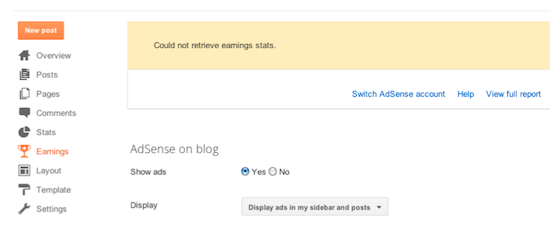
Error message in BloggerThe error message above can occur when 3rd-party Access has been disabled in your AdSense account. To re-enable access to your AdSense account by Blogger, please log in to your AdSense account, and click the Account Settings link. You'll see an enable access link next to blogger.com, you must click this link in order to create ads with Blogger tools. You will then be able to log back into blogger.com and continue setting up AdSense from the Earningstab.

AdSense settings

About the Blogger "Earnings" tab

The Earnings tab in Blogger makes it easy to enable AdSense ads on your blog. Once your account has been approved, Blogger retrieves your earnings data so you don't need to visit the AdSense dashboard to access basic earnings information.
 AdSense Report
Once you start generating AdSense impressions, you'll begin earning money when people click on ads that appear on your blog. The earnings report (visible when you click the Earnings tab) includes a drop-down bar with Today, Yesterday, Last 7 Days, This Month, and All time.
Selecting an option will retrieve the relevant report directly from AdSense.
All time
If you're an existing AdSense user, you'll notice that Blogger created a new channel (with the URL of your blog) in your account. If you have had AdSense ads on your blog before using Blogger’s AdSense integration to insert ads into your blog, note that All time will retrieve data only from the time you connected Blogger to your AdSense account.
This does not affect your overall AdSense reporting, available directly from AdSense.
Terminology
The AdSense report visible from the Earnings tab contains basic information about how many ads have run on your blog, how many clicks were generated, and how much revenue you've earned. Each term in the report is defined below:
Page views: A page view is generated every time a user views a page displaying Google ads. We'll count one page view regardless of the number of ads displayed on that page. For example, if you have a page displaying three ad units and it's viewed twice, you'll generate two page views and six ad unit impressions.
Clicks: The number of times the ads were clicked on in the given reporting period.
Page CTR (Click-through rate): The number of ad clicks divided by the number of page views.
CPC (Cost per click): The average amount paid by the advertisers for each ad click.
Page RPM (Revenue per mille): This is revenue per 1,000 page views. RPM = (Page views x CTR x CPC) / 1,000

Easy monetizing of your blog with AdSense

The more success you have with your blog / website, the more time and money you're going to invest to update it and host it properly.
At some point you may think: wouldn't it just be nice to have my site pay for itself?
Well, that is actually easier to achieve than it sounds! A decent hosting plan should cost you no more than $6.95/month. However, that's quite a low figure here and most people make many many times more than that in ad revenue...
By properly monetizing your blog site it is actually possible to have it pay, not only for the hosting, but also for the time you spend working on it.

WHY ADSENSE?

First, because AdSense is a very simple and proven solution that already pays for hundreds of thousands of blogs/websites accross the world!
Also, AdSense is provided to you by Google which not only makes it reliable but also trustworthy. Once you have earned money from Google, you can actually trust them to pay it to you!
Finally, because the ads will be contexual, i-e they will be relevant to the content of your blog/site. This way, your visitors will not be offended for seeing the ads on your site.

HOW DO I GET STARTED?

It's as simple as that:
  1. Sign up with Google AdSense. (It's totally free!) Then follow the provided instructions to put a little javascript snippet onto your blog skin or any web page you like. You may use our b2evolution AdSense plugin to make this even easier.
  2. When visitors view your site they see contextual text ads that automatically adjust to the contents of each page / blog post so that they are always relevant. No flashing images, just relevant text links! :)
  3. When a visitor clicks on an ad link, Google records the click and you get paid for it. Get ready for a monthly check from Google ;)

WILL IT RUIN MY BLOG DESIGN?

You can choose the exact position and colors of the text ad blocks you place on your site.
Below are two examples of blogs that incorporate text ads and successfully pay for themselves. Judge for yourself:
  • Example 1: Ad links at the end of the blog post.
  • Example 2: Ad links at the top of the page.
    Note: as you can see, AdSense is not limited to English!

MINI FAQ

Google has an extensive FAQ about this program. Here's our additional mini FAQ about integrating AdSense with your blog. Feel free to contact to me by email for further information.
How do I integrate AdSense into my blog?
Try the AdSense plugin for b2evolution!
How do I integrate AdSense into my blog without the plugin?
You just copy/paste the AdSense code from Google into your blog template.

How to choose a new bank

Image: Bank Vault © Corbis 

Are you looking for another financial institution to handle your fortune? Here's what to ask.

If you're among the many customers fed up with high bank fees, poor service or low interest rates, you may want to switch banks or trade your bank for a credit union.
"You used to just decide if you wanted to get a toaster or a microwave when you opened a new account, or go to the bank with the most convenient branch," says Mitchell Freedman, the CEO of MFAC Financial Advisors in Westlake Village, Calif. "Today, bank fees can hit you in ways you never thought about, so you need to carefully compare your continuing costs of banking."
Making that comparison isn't so simple.
"Among the 12 largest banks, the median number of bank disclosure pages for checking account policies and fees is 69 pages. Believe it or not, that's an improvement over 2011, when the median was 111 pages. There's no way a consumer could wade through all that," says Susan Weinstock, project director for Safe Checking in the Electronic Age, a project by the Pew Center on the States in Washington, D.C.
The following seven questions can help you find the bank that fits your financial needs.

HOW LARGE A BALANCE IS NEEDED TO AVOID FEES?

To make it easier for consumers to comparison shop, the Pew Center developed a simple disclosure form that five of the largest banks and three of the largest credit unions have adopted, Weinstock says. Consumers need to know the minimum deposit required to open an account and the minimum balance required to waive monthly bank fees.
"Be aware not only of the upfront price of opening an account but of continuing requirements," Freedman says. "Some accounts require a direct deposit or a recurring payment through their site to avoid monthly service fees."
In addition to the monthly service fees, you should also check on other fees that you can be charged before you switch banks, such as a stop-payment fee, deposited item return fee, account closing fee and nonsufficient funds fee.

HOW HIGH ARE THE FEES FOR OUT-OF-NETWORK ATMS?

"Most banks and credit unions participate in a network of ATMs, but if you rely often on an ATM for withdrawals, you should check on the fee for using an out-of-network machine," Weinstock says. "Usually there's no fee for using one in your bank's network, but your bank or credit union should disclose the fee it charges for using another network. There's also a fee from the ATM owner, and that will be disclosed on the ATM itself."
Freedman says consumers who travel frequently should consider opening an account with a national bank that offers ATMs around the country.
"ATM fees may be less important to people who don't use them a lot or who choose a bank or credit union with an ATM convenient to their work or home," Freedman says.

WHAT ARE THE OVERDRAFT PROTECTION OPTIONS?

While you may hope you never have to rely on overdraft protection, you should make sure you understand your options and their costs before you switch banks.
Weinstock says many consumers don't understand that not signing up for overdraft protection could be a good thing. Your debit card will be declined or your check will bounce without it, but there's no fee if you opt out of overdraft protection.
"If you opt in for protection, the cheapest way to do it is usually to have funds transferred from a savings account, a line of credit or a credit card. The median transfer fee is $12, and the median overdraft fee is $35 per transaction," Weinstock says.
Consumers should compare the transfer fee, overdraft penalty fee, maximum number of times an overdraft penalty fee is applied per day, minimum amount required to trigger an overdraft fee and extended overdraft penalty fee charged for each day the account is overdrawn.
"Overdraft protection is a double-edged sword," Freedman says. "It can be terrific and enable you to lower your risk of a bounced check, but you could end up paying a high transaction fee and a hefty interest rate if you sign up for a line of credit."

HOW SOON ARE DEPOSITED FUNDS AVAILABLE?

While some banks put a hold on certain types of deposits, Freedman says some deposits are instantly credited.
Weinstock says financial regulations require the first $200 of any deposit be available the next business day following a deposit, but banks vary in how soon the rest of the deposit is available.
"Fund availability is extremely important, especially for people living paycheck to paycheck," Weinstock says. "Some banks say the business day ends at 2 p.m., so you need to check that information in their disclosure boxes."
Weinstock says you also should find out the bank's process for handling deposits and withdrawals. Most banks process deposits first, then the withdrawals from the same day, but others credit deposits last.
"Some banks handle the largest withdrawals before smaller ones that come in on the same day, which can make it more likely that you'll overdraw multiple times," Weinstock says.

Making money online

Making money online used to pretty much require you to have your own Web site, products to sell and some marketing savvy. But a new generation of dot-coms have arisen that will pay you for what you know and who you know without you having to be a web designer or a marketing genius. 
But it's hard to tell hype from the real deal. I did a search on "make money online" and "making money online", and much of the information out there is just promoting various infoproducts, mostly about Internet marketing. I see why people sometimes ask, "Is anyone making money online besides Internet marketing experts?"
So I put together a list of business opportunities with legitimate companies that:
  • Pay cash, not just points towards rewards or a chance to win money
  • Don't require you to have your own Web domain or your own products
  • Don't involve any hard-selling
  • Aren't just promoting more Internet marketing
  • Give a good return on your time investment
In the interest of objectivity, none of the links below are affiliate links, and none of them have paid or provided any other consideration for their presence here. These are legitimate companies with business models that allow you to get paid for a wide range of activities. 
Help friends find better jobs.
Sites like ReferEarns, Zyoin, Who Do You Know For Dough?, and WiseStepp connect employers with prospective employees, many of whom are already employed and not actively job-hunting, via networking - the people who know these qualified candidates. Rewards for referring a candidate who gets hired range from $50 on up to several thousand dollars - not chump change. If you know a lot of job-seekers (and who doesn't these days?), this is a great way to break into the recruiting business with no overhead.
Connect suppliers with buyers.
Referral fees are a common practice in business, but they haven't been used much in online networking sites because there was no way to track them. Sites like Salesconx, InnerSell anduRefer now provide that. Vendors set the referral fees they're willing to pay (and for what), and when the transaction happens, you get paid. uRefer also allows merchants to set up referral programs for introductions and meetings, as well as transactions.
Write.
A growing number of sites will pay for your articles or blog posts. Associated Content andHelium will "pay for performance" based on page views for just about anything you want to write about. Articles on specific topics they're looking for can earn direct payments up to about $200. The rates are probably low for established writers, but if you're trying to break into the field and have time on your hands, they're a great way to start. Also, a lot of companies are looking for part-time bloggers. They may pay per post or on a steady contract. Our Weblogs Guide posts blogging jobs weekly in the forum.
Start your own blog.
You don't have to have your own Web site, or install blogging software, or even figure out how to set up the advertising. At Blogger you can set up a blog for free in less than five minutes without knowing a thing about web design, and Blogger even automates setting up Google AdSense so you can make money off your blog by displaying ads and getting paid when people click on the ads. To make even more money from it, set up an affiliate program (see below) for books, music, etc., and insert your affiliate links whenever you refer to those items. You'll have to get a lot of traffic to become a six-figure blogger, but pick an interesting topic, write well, tell all your friends, and you're off to a good start.
Create topical resource hubs.
Are you an expert on a particular niche topic? Can you put together an overview of the topic and assemble some of the best resources on the topic from around the web? Then you can create topical hubs and get paid through sites like Squidoo, HugPages and Google Knol. Payments are based on a combination of ad revenue and affiliate fees. You'll get higher rates doing it on your own, but these sites have a built-in supply of traffic and tools to make content creation easier.
Advertise other people's products.
If you already have a Web site or a blog, look for vendors that offer related but non-competing products and see if they have an affiliate program. Stick to familiar products and brands - they're easier to sell. To promote those products:
  • Place simple text or graphical ads in appropriate places on your site
  • Include links to purchase products you review or recommend in a blog, discussion forum or mailing list you control
  • Create a dedicated sales page or Web site to promote a particular product
They all work - it just depends on how much time you have to spend on it and your level of expertise with Web design and marketing.
Microstock photography.
You don't have to be a professional photographer to sell your photos for money. People are constantly in need of stock photography for websites, presentations, brochures and so on, and are willing to pay for the right image. People generally search for images on stock photography sites by keywords, not by photographer, so you have the same chance as anyone else of having your image picked. Just be careful that you don't have images of trademarked brands, copyrighted art or people's faces that are readily identifiable (unless you have a model release), but just about anything else is fair game, and I promise - you'd be amazed what people need pictures of, so don't make any assumptions. If it's a decent photo, upload it. Some sites to get you started include Fotolia, ShutterStock, Dreamstime and iStockphoto. The great thing about this is that it's truly "set it and forget it".
The above list is by no means comprehensive, but it highlights some of the new and interesting ways to make money online without investing any money, without having a product of your own, and without having expert sales and marketing skills. Most of all, unlike taking surveys or getting paid to read e-mail, the potential return on your time investment is substantial.

Best Ways Adsense Can Work For You

If you are not familiar with Adsense you should consider looking into the many features that it offers. Adsense is relatively new to the internet world, but it has proven to be a very ef.. 

2: 3 Ways Adsense Can Work for You3 Ways Adsense Can Work for You 
If you are not familiar with Adsense you should consider looking into the many features that it offers. Adsense is relatively new to the internet world, but it has proven to be a very ef.. 

3: Simple Ways to Make Adsense Work for You 
If you are not familiar with Adsense you should consider looking into the many features that it offers. Adsense is relatively new to the internet world, but it has proven to be a very ef.. 

4: Adsense Program 
You may not know what Adsense Program is but you've probably heard it before. Adsense program is one of the hottest ways to make passive income for people with all types of websites. The.. 

5: Make Money Online with Adsense 
Making money with Adsense is a fantastic online money making opportunity for newbie¡¯s. All you need is a site with at least 20 pages of content and well-placed keywords and you'll be on your .. 

6: Autopilot earning with adSense 
When I first heard about adsense by I did not pay attention to it as I do not have my own website to put it on and I did not even know what a blog was back then.I have spent many sleepless nigh.. 

7: Easy steps to add adsense on word press. 
It's easy to insert adsense code on blogger. Yeah it's so easy because now is the owner of blogger or blogspot. But how if you using Wordpress. It's so difficult to insert adsense code on Wordp.. 

8: The Adsense Tips Your Blogs 
One of the easiest ways to attract visitors to your blog, even if they are across the globe is by using adsense. This article is designed to give you some solid adsense tips. There are m.. 

9: The Adsense Tips Your Blogs 
One of the easiest ways to attract visitors to your blog, even if they are across the globe is by using adsense. This article is designed to give you some solid adsense tips. There are m.. 

10: How To Make Money Online From Adsense 
Earning a great deal of money by working online become popular in the lastfew years. Online webmasters make big money from their own web sites through Adsense. If you never know about Adsense.

How to get more visitors to your site

As a Google Analytics customer, you've shown that you really care about attracting high-quality visitors to your website. Now I'd like to suggest a way for you to bring in even more customers.

Your current customers most likely search for your business by name (e.g. "Anna's bakery"). But prospective customers tend to search by topic and city, such as "Restaurants in New York" or "Florist in San Francisco". With an ad on Google, you can make it easy for people to find you using the words they choose.

GETTING STARTED IS EASY.

To help you find more customers, we'll give you $100 in free Google ads when you spend your first $25. For many businesses, that free $100 is enough for an extra 1 month of advertising. You control your budget, and can stop or change your ads at any time.

Try an ad on Google and see if more customers find you. To redeem this offer go togoogle.com/ads/analytics or call
1-800-903-0274 before June 30, 2013. Please use this offer code: 9QCRJ-YXYWY-66DK. (Offer valid for new customers only.)

Thanks for your partnership with Google.

Best wishes,

Brett Willms
The Google AdWords Team
                                                                                                      information from google mail.

Financial Services >> Electronic Money Transfer Service BD

What is EMTS?
The regular paper based money order service of the post office seemed a time consuming, expensive and inefficient approach of remit money to any part of the country. There was a demand for quick transfer of money to locations where the beneficiary can collect and use it instantly. With this perspective in view, Bangladesh Post launched a new money order service named Electronic Money Transfer Service (EMTS), commonly known as Mobile Money Order Service. This fulfilled the expectations of people to remit the desired amount of money to their near and dear ones so as to utilize when they need. This is mobile as well as web based remittance service available in all important post offices of the country. The sender can send the money within a minute and recipient/beneficiary can collect it instantly. Both sender and recipient get confirmation of the remittance and disbursement as soon as it is made in their mobile phones.
Area Coverage :
This service is available in all important post offices of the country. Presently 2750 post offices provide the EMTS which is covering all district, upazilla/thana and important/busy rural post office locations. Every month hundreds of post officials are being trained and the service is expanded to those locations.
EMTS Tools/Devices:
Bangladesh Post maintains a server and call center to monitor and support the service. All Electronic Money Transfer Service locations (post offices) are equipped with computer, internet connectivity and/or mobile phones which are used to send the issue or payment request to the server.
Procedure: The sender goes to the post office and fills up an issue form (EMO -1) giving required information like sender name, address, mobile phone number, recipient's name, address mobile phone number, amount of money to be sent etc. The post office staff sends the information to the central server through the computer or official EMTS mobile phone. When the request is accepted and confirmed by the server through issuing SMS generating a 16 digit unique PIN to senders mobile phone and a separate confirmation message is sent to issuing post office. The sender shall inform the recipient to collect the money from his/her nearest post office. The recipient goes to the post office and again fill up the disburse form (EMO-2) and claim the money showing the PIN. The post office counter operator verifies the information given by the recipient from server with those used earlier by sender; if everything is match the disbursement procedure is made. As soon as the disbursement is completed the sender is again confirmed by another SMS generated by the server.

FEATURES
1.Remittance in a minute
2.User Friendly- adoption of mobile phones & applications
3.Maximum Area coverage: Locations distributed throughout the country
(presently 2750 POs), to be expanded to all Post Office locations
4.Transaction security ensured by a 16 digit auto PIN generation mechanism
5.Independent of Mobile Operator-customer enjoying mobile operator's service can use this service.
6.EMTS devices not specific to power sources like electricity -have freedom of using any Source of Power (electricity, battery, solar charger)
7.Ensure customer satisfaction- Daylong well acquainted Help Desk Service
8.Optional Corporate Services:
a)One 2 Many transactions-Option for Salary Disbursement
b)Many 2 One Transactions- Option for collection of tution/Admission fees from students
9.Location Independent Disbursement
10.Widely used Network Partner- Banglalink Mobile Operator
11.Database Management and Security-VPN Connectivity
12.Scope to add new value added service and future expansion 

Search Engine Optimization (SEO) for Beginners - Tutorial Part 2

SEO Title Tag

The first and most important part of your on-page SEO is the title tag (<title></title>). Many people who outsource or create a site in a WYSIWYG editor completely forget about the last of the meta tags that still gives some quality ranking love from search engines.
The benefits of using optimized title tags are three fold:
  1. A user searching for your keyword will see your site's link highlighted in the search engines if your page's title is the same as the phrase they searched for. This drastically increases click through and can even give you more traffic than those who rank above you if their title tags are not optimized.
  2. Increase your rankings on the search engines.
  3. Help the engines distinguish between pages that might look similar.

Higher Clickthrough Rates

Search engine optimization isn't just about showing up number one on search engines. Rather, it's about getting the all the traffic that you deserve from the search engines. If you rank #6 for "free hats" and you and your competitors forget to include that in the page's title tag, chances are, the person doing the search won't see much difference between your site and the others.
However, if you were to change your website's title text to target your most important keyword phrase "free hats", then when someone completes the search for "free hats", they'd see your site show up in bold. This technique will greatly increase the user's desire to view your site first, as your site looks much more relevant and targeted.

Better Rankings

All too often, people believe that the title tag is a place to list the business and domain name of the website. This is wrong and is wasting one of the easiest ways you can tell the search engines what the a page is about and how they should categorize it. While humans might not notice the title tag, search engines certainly do.
Use this opportunity to choose the most important keyword that you want to go after and get the free ranking boost that so many websites are missing out on. If you still want to include your domain or name of the company, do it after your keyword, followed by a dash (e.g. "free hats - hatsemporium.com") to show that your keyword is the most important.

Help the Engines Distinguish your Pages

It's not easy being a search engine. They crawl the web day and night, taking the information from the web and trying to categorize it in a useful manner so that users can find what they're looking for. Make their job easier. Post clearly what the topic of each page is, using title tags, and help the search engine to distinguish one page from another.
You may have two pages that are quite similar and it may require a little thought to point out how they different. Don't make the search engines figure out for themselves because they might make a mistake. Instead, make the decision for them. Spell the differences out for them and help your rankings in the process. This is just one strategy in avoiding the duplicate content penalty, which we'll be getting into greater depth later.

SEO Header and Bold Tags

Although the internet has changed a great deal in the last ten years, one thing that has remained status quo is the way that webmasters designate topics and things of importance. Topics of a page are often set with header tags <h1> though <h6>, while important items are put in bold to make sure that the user noticed them. However, not just the user notices these attention-grabbing tags. Search engines also use these as primary indicators of what a page is about and what content its creator thought was most important.

Header Tags - <h1> through <h6>

Header tags are a great way to help boost your search engine rankings. If you're creating a page about "free hats" and would like to rank for it, there's nothing shady at all about including a nice big <h1>Free Hats</h1> at the top of the page to make sure your users and the search engines know what your page's subject is. However, as with other search engine strategies, it is important not to stuff too many keywords into these tags. A good rule of thumb is to include no more than 3 or 4 <h1> tags per page, and always have at least a paragraph or two of text between your header tags.
A page that consists entirely of header tags looks pretty spammy to search engines, and it isn't very useful to your visitors.

Bold, Italic, and Emphasis

When you've used up your quota of header tags on the page, don't stress out. There are still plenty of tools to target your keywords with. When mentioning your keywords throughout the page, it's helpful to put them into italics, bold, or emphasis (<em>) to make sure the search engines know that these words are important. 
Often people use a lot of flash animations and CSS <span> tags to format text, but search engines don't have an easy way of determining either of these. Why make the search engines work harder than they need to? Use these basic HTML tags and help yourself (and the engines) out!

SEO Keyword Use

So you've researched which keywords you want to target, but just putting the keywords in your <title> and <h1> tags is not enough. If you stop there, you're not going to be able to cover all the bases or pull in as much search traffic as you could. When doing on-page optimization for your selected keywords, there are three things to take into consideration:
  1. Keywords Density - How many times is your keyword mentioned on your site? If it's too much, you'll look like a spammer; if it's too little, you won't look like a relevant match and the search engines won't consider your site.
  2. Keyword Variation - Altering versions of your keywords will help you capture hidden search engine traffic.
  3. Similar Keywords - These are closely related topics to your keywords that will aide the search engines in correctly categorizing your traffic.

Keyword Density

Although some SEOs will talk about aiming for an exact proportion (e.g. the number of times your keyword appears divided by the total number of words on the page), it's a little too much work for something that will take care of itself as long as you know how to write well! Use your keyword frequently on your site, but not so much that it makes the page look weird or a sentence sound awkward. If you just use the keyword once at the top of the page and then reference the keyword as "it", for the rest of the article, you'll definitely be using it too little.
If you want some numbers, you should use your keyword at least three times on the page. This does not include keyword variations.

Keyword Variations

You may have found a couple of high traffic keywords using a keyword research tool, but those estimates often group similar keywords, alternate spellings, and plurals into a single word. Valuable traffic is hidden when using those tools. This hidden traffic lies in all the subtle variations of your keyword that someone may search for.
  • Plurals - The easiest way to optimize your site is to include the plural version of your keyword at least a couple of times on your page. Nearly every keyword can do this (instead of "free hat", try "free hats").
  • Misspellings - Although it may make your site look a little unprofessional, including a very common misspelling of your keywrod is one of the easiest ways to rank #1 for that exact spelling and get some free traffic. This is one of the fun things to experiment with after you've optimized the rest of your site.
  • Acronyms - If your keyword is an acronym like SEO, write out the words completely (Search Engine Optimization) so that you can target those people who do not know the acronym.

Similar Keywords

If you're making a page to target "big hats," consider changing up the adjective "big" to its synonyms, like "huge," "giant," "large," "humongous," or "oversized." You can also use the names of specific words that relate to "big hats," like "cowboy hat" and "sombrero." By using this tactic, you give yourself a chance to rank for those similar keywords, plus you let the search engines know more about your page and what it's about. The more a search engine knows about your page, the better off you're going to be!

SEO Internal Linking Structure

The honest fact is, if company owners knew how important that the internal linking structure of a site was to a site's performance on the search engines, they'd have multiple dedicated staff working just to make sure they had it optimized 100%. This topic is a little advanced, but it's helpful to break the inner linking structure down into three parts:
  1. Page depth
  2. Quantity of Internal Links
  3. Quality of Internal Links

Page Depth

Page depth refers to the number of required clicks to get to a page from the homepage. Pages that are available in one click are deemed more important than those that are nearly hidden and require more than 3 clicks to reach. It might seem a little strange, but if you can visualize your website in a tree graph, you will easily notice why certain pages are performing poorly in the search engines.
By organizing your site in this format, you can see which pages are getting a lot of page depth love and which are hurting. If you have a lot of worthless pages and few important product pages, you might take this opportunity to restructure your site.

Quantity of Internal Links

This point is simple; the more internal links you have that point to a certain page, the more important search engines believe that page to be. A common page that ranks well on almost every site is the homepage. This point will continue to be true for many years because nearly every webmaster programs their site so that every page has a link back to the homepage.
So how do make your other pages benefit from this? Does that mean you should have every page on your site include a link to EVERY SINGLE PAGE in your site? No. That's an obvious red flag to search engines, and you'll be seen as a spammer if your site has a couple of paragraphs and then 500 links to every other page on your site.
A better strategy would to have a "Top Products" section that includes a link to pages you want to receive the most link love. Another strategy is to have a link for each of the major areas of your site. This will help give those areas a lot of link love, and in turn, they'll be able to get more link love to the pages contained within them.

Quality of Internal Links

Just including a bunch of internal links to an important page is not enough; they also need to be high quality links. For your most important pages, make sure the links they receive have as many of the following criterion as possible:
  1. Anchor Text - If you're targeting a certain keyword(or keywords) make sure the internal links have the keyword in the anchor text. Also, bonus points for using slightly altered anchor text throughout your site.
  2. Link Position - The higher a link occurs in the HTML, the better. If you link to "cowboy hats" at the top of the page, but "sombreros" towards the bottom of the page, search engines are going to view the link to "cowboy hats" as more valuable than the link to "sombreros."
  3. Link Zone - The best scenario for link love is to link from one page to a highly-related page. The closer the subjects of each are in topic, the higher the amount of link love that will be transferred. For example, it is better to link form a page about "cowboy boots" to a page about "cowboy hats" than it is to link from a page about "tacos" to a page about "cowboy hats." This doesn't mean you shouldn't include links on pages that are different, but just keep in mind that the link love will not be as strong as it could be.

How to Be a Millionaire : Free Tips

 
Here are some tips that will help us on our way to being millionaires: 
Develop a millionaire mindset
The first tip to be a millionaire is to develop the millionaire mindset, which means to be a millionaire think most of the time, always thinking how to how to become a millionaire, be aware of all the opportunities that allow us to be millionaires and so on.

To develop the millionaire mindset also involves setting goals to help us achieve our main objective which is to be millionaires, commit to those goals and make every effort to achieve them, and act according to these goals and do things that divert us of them.
Spend less
The following advice for being a millionaire is to spend less, which means considering every expense, avoid unnecessary expenses, eating little, always look for offers and discounts, compare prices before you buy it, do not buy it again if we can buy used, do not buy if we can rent , rent if you can borrow.
Spend some means to live below our means, but it is advisable to occasionally give us some treats in order to develop our mindset of a millionaire, for example, go to the best restaurant, best stay at the hotel, or make any other thing we would do if we were already millionaires.
Save
To become millionaires a fundamental requirement is the habit of saving, ie the habit of devoting a portion of our total revenue to a stock savings, then we will to start investing.
It is advisable to save at least 10% of our total income, even if it is difficult for us no matter initially start with 1%, the idea is to acquire the habit of saving up to go slowly increased this percentage.
Invest
The secret of wealth is not so much money coming in, but what you do with it, that is, not so much income one has, but their ability to manage your money, whether to spend little, save and, above all, to invest.
To start investing, you do not have much money, many wealthy people started with less than $ 1000, plus, if we lack money to invest, we could borrow or partner with someone.
Another tip is that before we invest well informed and consider it an investment, not invest in something that we do not know or understand completely, if that were the case, we miss the opportunity, knowing that it will others.
Act
We had said that before investing is necessary to get information and analyze it, however, a tip is to avoid doing it too much, because when we come to the action, the opportunity might already be long gone and most likely another and taken.
Before investing is important to prepare, learn, investigate, analyze and plan well, but most important is to act, not prepare, learn, investigate, analyze or plan too much, take an idea (which does not even have to be very good) and put into practice if we are convinced of it, knowing that there will be time to fix the road.
Constantly trained
Another tip to be a millionaire is to train constantly, whether studying, reading books, taking courses, listening to tapes, attending seminars, or simply researching on the Internet.
Our goal must be constantly trained to be prepared to identify, analyze and learn from the best possible opportunities presented to us, but also to become the best at what we do.
Patience
If we want to become millionaires, we must be patient and not expect to become millionaires overnight, but know that the way to being a millionaire is a long way.
For example, do not speculate with our investments and taking unnecessary risks to earn quick money, but have a long-term discipline to save and accumulate money through the years, ensuring that our wealth grow from year to year.
Keep things simple
Another tip to be a millionaire is not to complicate your life and always keep things simple.
For example, developing complex business plans over a hundred pages, do not try to know everything before you invest, do not do work that could be delegated, not trying to appear more than what we actually know, and so on.
Surround yourself with the right people
Surround yourself with the right people is to identify and hire competent people who are specialists in their respective areas, and that together they complement and form a great team.
But also, surround right people involved to get together with people who have our same goals of wealth, which motivated or inspired us or which we can learn, and, conversely, away from negative people, judgmental or pessimistic that can be a negative influence for us.
Find mentors
Another tip is to find mentors and ask them to share with us their secrets to being a millionaire, to give us valuable information, or help us solve our problems.
Find one or two mentors, and not be afraid to ask for his help (find that rich people love to share ideas and help others), inviting them to eat or drink coffee, tell them that we admire their achievements and we hope also to become rich and successful.
But to find mentors, find people who do or have done what we want to do and, especially, that have had proven success in this, and do or have done things that tell us to do.
Reducing taxes
Much of our profits will go towards the payment of taxes, so if you want to be millionaires, another tip is to learn to lower our taxes as much as possible, but legally.
To do so, as our wealth grow, we need a good accountant and a good tax lawyer and work with them to develop and implement all the tax deductions that we are legally possible.